
A Crape Myrtle Care Guide from the Experts
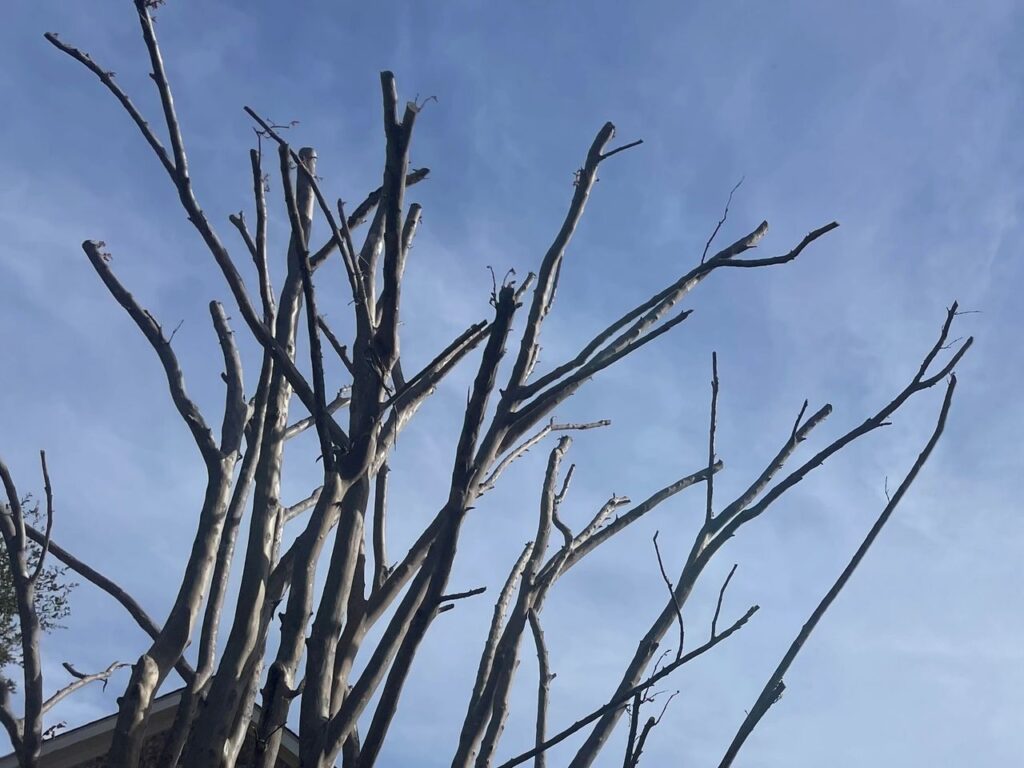
Many Austin landscapes feature the vibrant crape myrtle, but improper pruning, often called “crape murder,” is a common sight. Simply put, “crape murder” is the indiscriminate topping of these trees. People often think they’re doing the right thing by cutting them back severely, believing it will lead to more blooms. While a temporary increase in flowering might occur, the long-term consequences for the tree’s health and structure are severe.
Why does this happen? Crape myrtles bloom on new wood and are vigorous growers. The idea is that severe cuts will produce a flush of new growth and flowers. Also, some people top crape myrtles to provide clearance for larger trees, believing they’re competing for sunlight. Sadly, this weakens the crape myrtle and makes it more susceptible to problems.
Topping is the practice of cutting branches back to a uniform height, which results in weak branch unions as the tree attempts to regrow. These weak unions break easily, especially in storms, leading to a misshapen, unstable tree. Large, open wounds don’t compartmentalize quickly, leaving the tree vulnerable to insects, diseases, and decay, shortening its lifespan.
Pollarding / Misunderstood and Misused
Sometimes, people top crape myrtles thinking they’re mimicking a technique known as pollarding. Pollarding is a pruning technique with a long history, traditionally used to manage trees for resources like firewood or animal fodder. It involves removing the upper branches of a tree, promoting a dense head of new growth, and then repeatedly cutting this growth back, leading to the formation of “pollard heads” or knuckles. Pollarding has been used for centuries in various parts of the world, a common practice in Europe for managing trees in woodlands and pastures, often for utilitarian purposes, providing a sustainable source of small-diameter wood. The tree is initially cut back to a desired height, and subsequent pruning maintains this height. This repeated cutting stimulates the growth of numerous shoots, creating the characteristic “pollard head.”
While crape myrtles can tolerate pollarding, it’s generally not the ideal pruning method for these trees in residential landscapes. Often, what people refer to as pollarding on crape myrtles is actually incorrect topping, which leads to the problems we discussed earlier. It is important to understand that properly done pollarding, is a repeated yearly process. Pollarding can create large wounds, which can be entry points for diseases and pests, and it requires regular maintenance to prevent the tree from becoming overgrown. In some cases, pollarding might be used to manage crape myrtles that have already been severely topped. However, it’s essential to do it correctly and understand the ongoing maintenance requirements.
It’s crucial to distinguish between proper pollarding and indiscriminate topping. Proper pollarding begins with an intentional cut at a specific height to create a “pollard head” or framework of branches, usually done when the tree is young. This framework is then maintained through regular, repeated cuts at the same points. Pollarding requires consistent, annual (or near-annual) pruning, new growth is cut back to the pollard head, preventing the tree from becoming overgrown, and this regular cycle of cutting and regrowth allows the tree to compartmentalize wounds more effectively.
Topping, on the other hand, involves making cuts at arbitrary points on the tree, often without regard for branch structure or growth patterns, there’s no established framework, and cuts are often made in the middle of branches. Topping is usually a one-time event or done sporadically, there’s no consistent follow-up pruning, and this leads to uncontrolled regrowth and weak branch unions. Often, topping is done out of a misunderstanding of proper pruning or a desire for a quick fix, it is not a sustainable or healthy practice for the tree.
Topping creates large, ragged wounds that the tree struggles to compartmentalize, and it results in weak, poorly attached branches that are prone to breakage. The “knuckles” that are formed through topping are more akin to large scared tissue, than the intended knuckle formation of pollarding. When it comes to crape myrtles, proper selective pruning techniques are almost always a much healthier and aesthetically pleasing choice, compared to either topping, or pollarding.
It’s important to understand that for residential tree care, pollarding should generally be considered a last resort, after other options have been explored. We recognize that homeowners often seek affordable tree care and may believe that more extensive pruning is beneficial, which can sometimes lead to trees being improperly pollarded or topped. However, this approach often leads to unintended consequences. Once a tree is pollarded, its growth rate can drastically increase compared to a well-maintained tree, requiring more frequent and intensive pruning. This rapid regrowth can also strain the tree’s resources and lead to further problems. Additionally, some tree species simply cannot tolerate heavy pollarding, and the practice can lead to the tree’s decline or death.
When pollarding is necessary, it must be performed with proper technique. Cuts should be made cleanly, just above branch unions, to minimize wounding and promote compartmentalization. It is best to seek professional help to ensure this is done correctly.
Understanding the long-term effects of pollarding and choosing qualified tree care professionals are essential for maintaining the health and beauty of your trees.
Proper Pruning
Proper crape myrtle pruning is about more than flowers, it’s about maintaining health, structure, and natural beauty. Here are a couple of ways we might go about approaching our tree. For more info, check out our article on the Four D’s of Tree Pruning.
Restoration Pruning For topped trees, we carefully select strong branches (leaders) and remove weak or crossing ones to guide the tree back to its natural form.
Selective Reduction Before any topping occurs, this technique allows you to maintain a desired height. We remove branches growing at awkward angles or crossing over each other, improving air circulation and light penetration.
Start Young Early pruning creates a strong, well-structured tree that needs less corrective pruning later. Young trees compartmentalize faster and adapt better to shaping.
Clean Cuts Make clean cuts just outside the branch union. Avoid jagged edges or tearing bark, as this hinders compartmentalization.
Protecting Your Tree
To ensure the continued health and longevity of your crape myrtle, be sure you prioritize proper pruning. Pruning cuts should be clean, precise incisions that minimize damage to the surrounding bark and cambium layer. This careful approach promotes efficient compartmentalization, the tree’s natural process of sealing off wounds to prevent decay. Also pay close attention to the formation of strong branch unions. By selectively removing weak or crossing branches, encourage the development of robust, well-supported structures that are less prone to breakage and decay.
Recognizing that crape myrtles, like Texas persimmons, have delicate, thin bark, take extra precautions to protect the base of the tree. Create a wide mulch ring around the trunk, avoiding volcano mulching This mulch serves as a vital barrier, shielding the bark from accidental damage caused by lawn equipment like weed whackers and mowers. This protective measure prevents potential entry points for pests and diseases, ensuring the tree’s long-term health. Additionally, the mulch helps retain soil moisture and regulate soil temperature, creating an optimal environment for root growth and overall tree vitality.
Annual Pruning?
Not always! Healthy, well-shaped crape myrtles may not need annual pruning. If you’re unsure, have a professional assess your trees. If you’re in the Austin area and concerned about your crape myrtles, give us a call 512-912-8733 or contact us online. At Adam’s Apple, we’re passionate about keeping your trees healthy and thriving for years to come!